Technique
Applying Gold Leaf
The adhesive used for applying Gold Leaf or Dutch metal leaf is known as gold size. Gold size is available in two forms: water-based and oil-based.
Water-Based Gold Size
Water-based size is a milky adhesive that dries clear. It can be prepared traditionally by mixing water and geletine or purchased ready-made from specialist suppliers. In addition to gilding, water-based size is often used in decorative crafts such as decoupage.
Oil-Based Gold Size
Oil size is a thick, honey-coloured medium that dries to a tacky finish. It is suitable for both interior and exterior gilding applications and is widely used for architectural and decorative work.
Gilding Glass for Verre Églomisé
When creating Verre Églomisé miniatures, I use transfer gold leaf applied to a glass panel using a thin, even layer of water-based size. The adhesive is hand-mixed using a traditional geletine recipe, allowing the ratio of geletine to water to be adjusted according to the requirements of each piece.
When the consistency of the size is correct, the gold leaf is drawn down tightly onto the glass surface. After a short period, the tissue backing can be carefully lifted away, revealing the delicate layer of gold beneath. Depending on the strength of the size and the drying time, subtle and often unpredictable patterns may form between the gold leaf and the tissue backing, creating unique surface characteristics.
The gilded glass panel must be allowed to dry completely before any drawing can begin. This stage marks the foundation of the Verre Églomisé process.
Drawing into the Gold
Selecting the right image for a gilded panel is as important as the gilding itself. The relationship between subject and surface is carefully considered to ensure the strongest visual impact in the finished work.
To begin drawing, the gilded glass panel is placed on a board covered with black velour. This provides a secure, non-slip surface and allows the panel to be turned over regularly so the image can be viewed through the glass as it develops.
The drawing process involves carefully removing areas of gold leaf to create light, shade, texture, and detail. Because the image is worked in reverse, every mark must be made with precision and foresight. Once gold leaf has been removed it can be challenging to correct mistakes, although repairs are sometimes possible with careful intervention.
The gradual emergence of the image through the glass is one of the most rewarding aspects of the process, as the final composition slowly reveals itself layer by layer.
Gold leaf
Gold leaf is supplied in books containing 25 sheets and is available as either loose leaf or transfer leaf. Both types measure approximately 80 mm (3 inches) square and are manufactured in a range of gold grades and shades. Gold leaf can be purchased from many specialist art and craft suppliers throughout the UK.
Loose Leaf
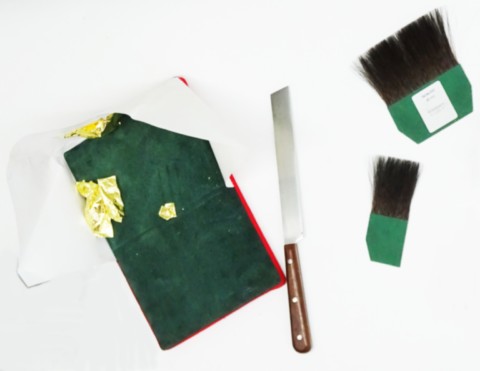
Loose leaf is extremely delicate and will disintegrate if handled directly. For this reason, specialised gilding tools are required to manipulate and apply it successfully. These include:
- A gilder's cushion – a soft pad covered in vellum or suede, fitted with a draught flap to protect the leaf from air movement.
- A gilder's knife – a razor-sharp knife used to cut and manipulate the gold leaf on the cushion.
- A gilder's tip – a fine flat brush, traditionally made from squirrel or badger hair, used to lift the gold leaf using natural static.
The gilder's cushion provides a stable working surface, while the draught flap helps prevent unwanted air currents from disturbing the fragile leaf.
Transfer Leaf
Transfer leaf is also genuine gold leaf but is pressed onto a backing sheet of acid-free tissue paper. Although generally more expensive than loose leaf, the tissue backing makes each sheet much easier to handle and apply, eliminating the need for specialist gilding tools. This makes transfer leaf particularly suitable for beginners.
Dutch Metal Leaf
An economical alternative to genuine gold leaf is Dutch metal leaf. Gold-coloured leaf is made from brass, while silver-coloured leaf is manufactured from aluminium. Dutch metal leaf is relatively inexpensive and ideal for experimentation and practice. It is also considerably thicker than genuine gold leaf, making it easier to handle without tools. Individual sheets are larger, measuring approximately 140 mm (5½ inches) square.
The World of Miniatures and Verre Églomisé
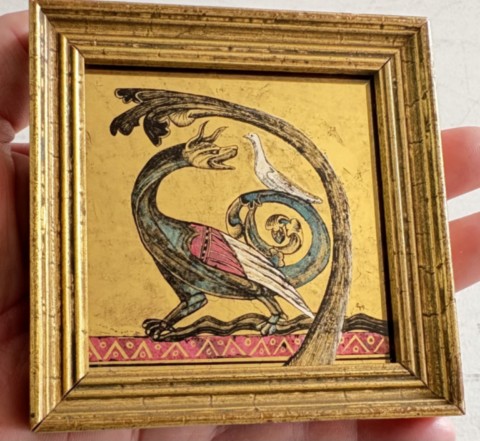
The world of miniature art is founded on two essential qualities: exquisite detail and infinite patience. The marks created when drawing into soft gold leaf are so delicate that they are often almost invisible to the naked eye. The process of gilding glass and incising intricate drawings into the surface of the gold requires the same dedication and precision. For this reason, the ancient technique of Verre Églomisé feels perfectly suited to the ethos of miniature art.
Although traditionally associated with fine detail on a small scale, Verre Églomisé can also be realised in larger works by applying multiple sheets of loose gold leaf to glass panels and employing the same meticulous drawing techniques.
For me, Verre Églomisé has become an extraordinary journey of discovery, continually pushing the boundaries of form, texture, and detail. Through experimentation, I have developed and challenged the technique by introducing layers of coloured leaf and varying gold sizes (adhesives). Along the way there have been failures, triumphs, and, above all, immense enjoyment in exploring the possibilities of this remarkable medium.
I work with gold leaf on glass using the ancient technique known as Verre Églomisé (pronounced Verr Egg-loam-eezay). The term describes the application of gold leaf to glass using a gelatin adhesive, or gold size. The technique was revived in the eighteenth century by the French decorator Jean-Baptiste Glomy, whose popularity became so closely associated with the process that his name gave rise to the term Églomisé.
While Verre Églomisé cannot be translated literally, it is generally understood to mean "gilded glass."
My work begins with a single glass panel gilded with 23-carat gold leaf. I then draw directly into the gold surface, creating light, shade, texture, and intricate detail. Because the image is created in reverse, the drawing becomes the back of the work. Once completed, the reverse side is painted with black enamel, and the finished image is viewed through the glass, revealing the luminous depth and brilliance of the gold beneath.